
Founder's statement
Planting the Flag
Why Lighthouse Community Development Corporation exists.
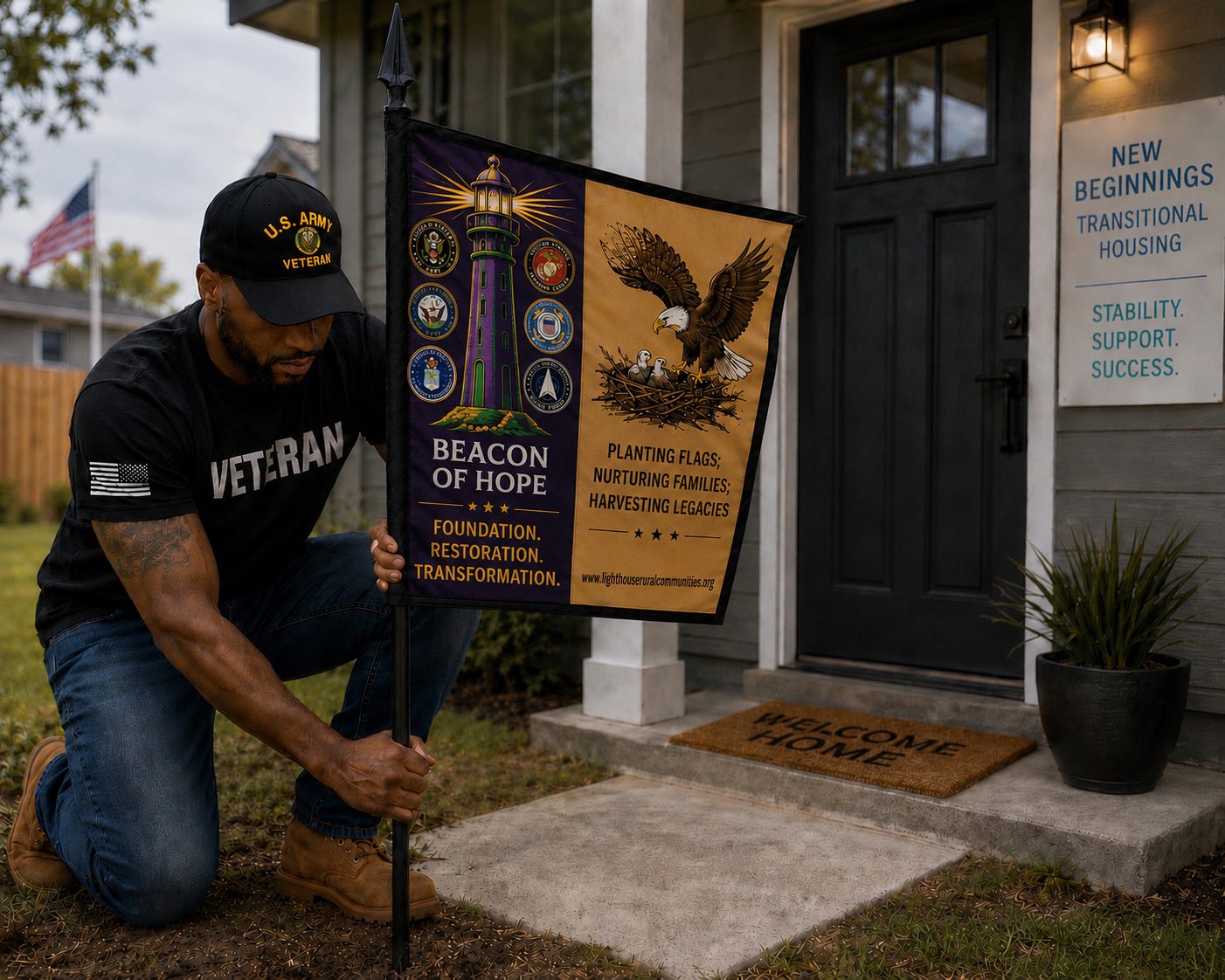
A statement of lived experience
Lighthouse Community Development Corporation was not built from a business plan first. It was built from a conviction, earned the hard way: through housing instability, health challenges, financial disruption, and the difficult maze of navigating social services alone.
That experience clarified a single, central thesis. Housing is not merely shelter. It is the stabilizing home base from which families recover, regain dignity, navigate the systems built to help them, and rebuild a sense of purpose. Take that home base away, and every other plan — a job search, a treatment program, a benefits claim, a child's school year — becomes harder to hold together. Restore it, and the rest becomes possible again.
Stable housing is the foundation for family recovery, economic mobility, health access, and restored purpose. That conviction is why this organization exists.
The need, verified
Progress made, and work still ahead
What the research confirms
The lived-experience thesis behind Lighthouse is not a hunch — it holds up against the public-health and housing research. Federal public-health guidance treats safe housing, transportation, neighborhood conditions, income, education, and health care access as major social determinants of health, alongside the broader social context a family lives in.
Housing instability — trouble paying rent, overcrowding, frequent moves, cost burden, and the threat or reality of eviction — is well documented to negatively affect physical health and a family's ability to access care in the first place. In other words, an unstable address does not just threaten a roof over someone's head; it threatens their ability to get and stay well.
Veterans
Veteran homelessness has fallen by more than half since 2010 — real progress worth acknowledging. But 32,495 Veterans still experienced homelessness in January 2025, and 13,518 of them were unsheltered. Outreach, housing stabilization, and community-based support are what keep that number moving in the right direction, especially in rural areas that national point-in-time counts can undercount.
Louisiana
The National Low Income Housing Coalition identifies an ongoing shortage of rental homes that are both affordable and available to extremely low-income households across Louisiana: just 42 such homes for every 100 extremely low-income renter households, a statewide deficit of roughly 115,000 homes. The Louisiana Housing Corporation's LIHTC pipeline is closing part of that gap — the work still needed is the community-level navigation and wraparound support that turns a new unit into a stable home.
The strongest funder-ready positioning
Lighthouse Community Development Corporation was born from lived experience with housing instability, health challenges, financial disruption, and the difficult maze of social-service navigation. That experience clarified a core conviction: stable housing is the foundation for family recovery, economic mobility, health access, and restored purpose.
This statement opens our grant proposals, board packets, donor appeals, CHDO readiness materials, and housing initiative briefs. It is the flag we plant before every conversation about what we build next.
Sources
- U.S. Department of Veterans Affairs, VA News — "Veteran homelessness continues downward trend: 56% since 2010" (2025 Point-in-Time Count: 32,495 total, 18,977 sheltered, 13,518 unsheltered).
- National Low Income Housing Coalition — Louisiana Housing Needs and The Gap: Louisiana.
- Louisiana Housing Corporation, via NCSHA — Affordable Housing Month release ($54,543,148 in 2024 LIHTC funding; 3,297 units created or rehabilitated).
- U.S. Department of Health & Human Services — social determinants of health guidance (housing, transportation, neighborhood, income, education, and health care access as major determinants).